Share this with friends

Alberta Sweetgrass

Wildfires wreak havoc

Alberta wildfire banner
Author: 
By Shari Narine Sweetgrass Writer TREATY 8 REGION
Volume: 
18
Issue: 
7
Year: 
2011

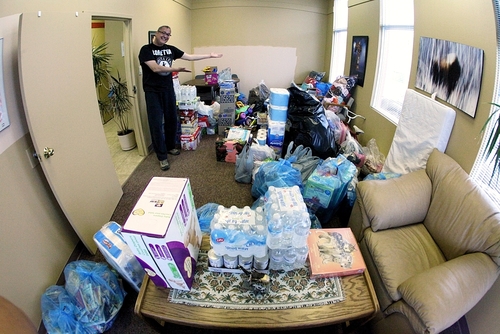
Wildfires that began surging through the Treaty 8 traditional territory in mid-May have left over 9,700 people displaced, with easily one-third of those being First Nations or Métis.

The first mandatory evacuation orders were issued on May 15. Although the town of Slave Lake with its 7,000 population-base was the largest centre to be impacted, many First Nations’ communities surrounding the town and north were also evacuated, whether voluntary or mandatory.

Almost 10 days after the first evacuation orders were issued, the government announced a phased re-entry plan. The four-phase plan, which included input from the Sawridge First Nation and endorsed by the Town of Slave Lake, the Municipal District of Lesser Slave River and the province, is sketchy on details as what it means for Treaty 8 members, said Joseph Jobin, chief operating office with Treaty 8 First Nation.

Related Content

GYPSD recognized for Aboriginal students success

Author: 
Compiled by Shari Narine
Volume: 
20
Issue: 
6
Year: 
2013

Aboriginal students in Grande Yellowhead high schools were nearly twice as likely to graduate last year compared to the provincial average. The three-year (grades 10–12) high school completion average for Aboriginal students in Grande Yellowhead high schools rose to 70 per cent last year, compared to about 50 per cent in 2011 and 2010. Alberta’s provincial three-year completion rate for Aboriginal students is 40 per cent, which has increased only slightly from 36 per cent in 2010. Passing scores on Provincial Achievement Tests were at 68.9 per cent for GYPSD compared to 58.3 per cent for the province. In contrast to the overall First Nations, Metis and Inuit stats, the six-year transition rate average for Aboriginal students continuing on to post-secondary studies fell nine points to 20 per cent in 2012. The provincial average was 30.2 per cent.

Related Content

Premier promotes Keystone XL in Washington

Author: 
Compiled by Shari Narine
Volume: 
20
Issue: 
6
Year: 
2013

In mid-April Premier Allison Redford made her fourth trip to Washington to reiterate her government’s support for the Keystone XL Pipeline project. She said the visit was to provide more information on Alberta’s regulations and she felt the trip was worthwhile. “We know there’s an awful lot of campaigning going on against Keystone. We want to make sure the other side is heard,” Redford said.  She added that while Alberta respects the regulatory process that needs to be carried out, she will return to the US as often as is necessary in order to promote the line. “It is a matter of building the case over time,” she said. She was joined by Cal Dallas, Minister of International and Intergovernmental Relations, and Diana McQueen, Minister of Environment and Sustainable Resource Development.

Related Content

NAIT, Cenovus provide youth leadership program

Author: 
Compiled by Shari Narine
Volume: 
20
Issue: 
6
Year: 
2013

NAIT and Cenovus Energy have launched an innovative program to help prNAIT, Cenovus provide youth leadership program

NAIT and Cenovus Energy have launched an innovative program to help promote Aboriginal youth leadership skills in First Nations in central and northern Alberta. The NAIT Aboriginal Youth Leadership Program, sponsored by Cenovus Energy, was recently delivered to 18 students between the ages of 15 and 18 in Heart Lake First Nation. This is the first community the program has been delivered in following a pilot in 2011 in High Level to participants from the three Dene Tha’ First Nation communities. The program helps students improve their grades, reduce school drop-out rates and improve employment opportunities.

Related Content

Métis Settlements Amendment Act introduced

Author: 
Compiled by Shari Narine
Volume: 
20
Issue: 
6
Year: 
2013

Last month Aboriginal Relations Minister Robin Campbell introduced Bill 19 Métis Settlements Amendment Act, 2013, which supports the previously announced Métis Settlements Long Term Arrangements. The amendments are the result of negotiations with the Métis Settlements leadership over the last year. “The arrangements provide the direction and the financial resources for Alberta’s Métis Settlements to reach their full potential and become self-sustaining communities,” said Campbell in a news release. Alberta is home to the only recognized Métis land base in Canada, comprising 512,121 hectares (1.25 million acres). The eight settlements are located primarily in the east-central and northern areas of the province.

Related Content

Red Cross helps out in emergencies

Author: 
Compiled by Shari Narine
Volume: 
20
Issue: 
6
Year: 
2013

The Canadian Red Cross responded to two calls for help on First Nations last month providing 72-hours of assistance in both cases. On April 20, the Canadian Red Cross Personal Disaster Assistance Team responded to a fire which took place on the Louis Bull reserve, providing groceries for six people, clothing for four adults and three children, diapers and formula for two infants. Accommodation was provided by the band for the first two nights. The Red Cross also provided teddy bears to the children, as well as blankets to all. On April 27, members of the Canadian Red Cross Personal Disaster Assistance Team assisted 16 adults and seven children affected by strong windstorms in the northern part of the Blood Reserve. The Red Cross provided emergency food and accommodation. The Canadian Red Cross provides food, shelter, clothing and additional services for 72 hours to people affected by personal disaster.

Related Content

ACFN joins voices calling for Protti’s resignation

Author: 
Compiled by Shari Narine
Volume: 
20
Issue: 
6
Year: 
2013

A month after the province named Gerry Protti as chair of the Alberta Energy Regulator the Athabasca Chipewyan First Nation joined non-governmental organizations and special interest groups to call for his resignation. Protti’s industry history which includes one of the founders of the Canadian Association for Petroleum Producers, an executive for Encana, and a lobbyist for the Energy Policy Institute of Canada, has brought “his ability to chair the Alberta Energy Regulator with transparency and accountability,” stated a news release from the ACFN. “Our community has been raising serious questions about the provinces environmental standards and monitoring. We have repeatedly demanded more meaningful participation in the development of the provinces new environmental monitoring projects. Instead of better engagement they appoint the former founder of CAPP as the Chair of the new Alberta Energy Regulator? This is unacceptable and insulting,” said ACFN Chief Allan Adam.

Related Content

Fort McKay proposes 20 km buffer zone

Author: 
Compiled by Shari Narine
Volume: 
20
Issue: 
6
Year: 
2013

Fort McKay First Nation appeared in front of the Energy Resources Conservation Board late April to call for the establishment of a 20 km buffer from its reserve in regards to the proposed Dover OPCO. The Dover project proposes a five-phase 250,000-barrel-per-day facility using Steam-Assisted Gravity Drainage technology. Fort McKay formally stood against the proposed project because Dover would not agree to adjust its project plan to accommodate a buffer to protect traditional territory surrounding Namur and Gardiner lakes, known locally as Moose Lake. Over the course of the hearings, Fort McKay presented extensive evidence of how the proposed project would affect the land and traditional way of life around Moose Lake. Fort McKay residents use the area to hunt, trap, collect berries and carry out traditions including use of the area as sacred burial grounds.

Related Content

Charges laid against Plains for largest oil spill in recent history

Author: 
Compiled by Shari Narine
Volume: 
20
Issue: 
6
Year: 
2013

Plains Midstream Canada ULC is facing three counts under the province’s Environmental Protection and Enhancement Act in relation to the largest spill in the province in 35 years, which occurred on Lubicon Cree traditional territory in April 2011. A ruptured pipeline leaked 28,000 barrels of crude oil and contaminated more than three hectares of beaver ponds and muskeg in a densely forested area. The Energy Resources Conservation Board said the company had inadequate leak detection and failed to test its emergency response plan. Nikki Booth, spokesperson for Alberta Environment and Sustainable Resource Development, said the charges were laid as a result of the department’s two-year investigation into the spill, which the province has now wrapped up.

Related Content

Supreme Court will not hear ACFN appeal

Author: 
Compiled by Shari Narine
Volume: 
20
Issue: 
6
Year: 
2013

The Supreme Court of Canada has refused to hear the Athabasca Chipewyan First Nation’s bid to block a ruling on Shell’s Jackpine oilsands mine expansion in northern Alberta. In October 2012, ACFN put forward a Constitutional challenge asking the Joint Review Panel to decide whether Crown consultation on the Shell application was sufficient. The JRP ruled it did not have the jurisdiction to consider ACFN’s constitutional questions and that any determination of Crown consultation would be premature. ACFN filed an appeal of the Alberta Court of Appeal’s decision with the Supreme Court of Canada in January 2013. “We are truly disappointed with this decision as we have diligently proceeded through legal avenues to have our rights upheld,” said ACFN Chief Allan Adam, in a news release.

Related Content

Peerless students make trip to Ottawa

Author: 
Compiled by Shari Narine
Volume: 
20
Issue: 
6
Year: 
2013

Peerless Lake Grade 8 students Taron Okemnow (left) and Shavannah Anderson attended the Forum for Young Canadians March 18-22 in Ottawa with their teacher Shonna Marko-Kwasny. The students were two of approximately 120 from across the country selected to attend the event. They toured Parliament Hill, met MPs, senators, public servants and business leaders, and visited the Canadian War Museum.  Shavannah met Green Party leader Elizabeth May. “We talked about Peerless Lake, my interests and I asked her about her job,” said Shavannah.

Related Content

Annual awards recognize students who have overcome obstacles

Last year’s Wahkotowin Society award recipients.
Author: 
By Heather Andrews Miller Sweetgrass Writer EDMONTON
Volume: 
20
Issue: 
6
Year: 
2013

For 25 years, the Wahkotowin Society has been recognizing the achievements of promising Aboriginal students in Edmonton.

“We wanted to celebrate those kids who are trying their best but may not have top marks in their subjects,” said society member-at-large Susie Robinson.

The Wahkotowin Society, a group of caring individuals, was spearheaded by Eva Bereti and others who wanted to give deserving students a pat on the back for trying to improve their lives. Bereti has been actively working with youth throughout her career as a long-time employee of the Edmonton Catholic School District.

“And most of all, we try to get them looking towards future post-secondary education,” said Robinson, who noted that the recognition luncheons were originally held at the Faculty Club at the University of Alberta so the students could be exposed to the campus and to the greater world offered there.

Related Content

Transition year Aboriginal students share their journey in university

Author: 
By Roy Pogorzelski Sweetgrass Writer EDMONTON
Volume: 
20
Issue: 
6
Year: 
2013

The “peanut butter and drymeat sandwiches” exhibit on display in the Rutherford Library Atrium features the visual and written work of 30 students, who explore the experiences of first year Aboriginal students at the University of Alberta.

The exhibit, which runs from April 12 to May 15, is a project that launches the journey through the U of A’s Transition Year Program. It stems from a course taught by assistant professors Christine Stewart and Keavy Martin in the Department of English and Film Studies, which aims to “Indigenize the Academy.”

“This is an open space installation located in a high traffic spot on campus that has the goal of transforming the U of A into becoming a more welcoming and inclusive campus through Indigenizing the institution” said Stewart. “Students engage in the transformation through their year-end final projects.”

Related Content

Teenager shows leadership, organizes rally on Earth Day

Author: 
By Paula E. Kirman Sweetgrass Writer EDMONTON
Volume: 
20
Issue: 
6
Year: 
2013

Casey Julian Thunderspirit has learned that strength is not always found in numbers. The 15-year-old organized a march and rally to celebrate Earth Day and the Idle No More movement in downtown Edmonton on April 22.

Elder Taz Bouchier, a frequent speaker at Idle No More events, says she is proud of Thunderspirit and his effort because of the leadership he is showing at such a young age.

 “It doesn’t matter the numbers that show up. It’s the heart and intention that you put into this. Even though the physical people are not here, the grandmothers and grandfathers on the other side honour your intention and they will take care of things,” said Bouchier.

The event began with a march from the Stadium LRT station to Churchill Square, where the rally portion took place. Although the event did not attract a large crowd, Thunderspirit maintained a positive attitude.

Related Content

Edmonton News Briefs - May 2013

Author: 
Compiled by Shari Narine20
Volume: 
20
Issue: 
6
Year: 
2013

Kelsey Wolver performed a hoop dance in Churchill Square during Earth Day celebrations in May.


The universality of sign language

The Art Gallery of Alberta hosted Occupy the Gallery last month in which students from the University of Alberta provided art work that depicted signs with meanings throughout history. On show were signs ranging from the ‘60s popular peace sign to more recent iconic images from the Idle No More and Occupy protest movements. The show exhibited work done by students from Michael MacDonald’s class. MacDonald, who teaches in the Department of Music and the Department of Modern Languages and Cultural Studies at the U of A, asked his students to “use symbols and symbolic language to produce art, to use art as a type of laboratory to do social science research.”

Related Content

Businesses recognized for excellence, giving

Author: 
By Darlene Chrapko Sweetgrass Writer CALGARY
Volume: 
20
Issue: 
6
Year: 
2013

To receive recognition from Métis Nation 3 and his peers for giving back to the community means much to Matthew Kinderwater, recipient of the inaugural Humanitarian Award.
“It’s wonderful to receive. It’s one of those places that you put yourself in other people’s shoes to understand what they’re going through. It makes me feel privileged,” he said.

Working primarily with corporate clients, Kinderwater operates a data recovery business, retrieving information from hard drives, memory cards, USB keys and other storage devices. His unique company, iCube Development, is only one of two in Western Canada that work at the manufacturing level.  iCube created its own equipment to retrieve data in house, a costly venture.

Related Content

Proclamation and conference seeks to inform, educate

Author: 
By Paula E. Kirman Sweetgrass Writer EDMONTON
Volume: 
20
Issue: 
6
Year: 
2013

The impact sexual exploitation has on the community has been recognized in a significant manner.

“A proclamation in a public space makes a statement that addressing sexual exploitation is a priority in Edmonton and recognizes the suffering caused by sexual exploitation,” said Kate Quinn, executive director of the Centre to End All Sexual Exploitation.

The proclamation was signed in downtown Edmonton on April 22, kicking off the week that was declared the Sexual Exploitation Week of Awareness.

Sexual exploitation has particular relevance for the Aboriginal community.

“Intergenerational trauma, poverty, and racism that raises barriers for Aboriginal people to find affordable housing and employment can create vulnerabilities and predators/traffickers/pimps search out vulnerable people,” said Quinn.

Related Content

Consultation process to continue for repatriation of Manitou Stone

Author: 
By Paula E. Kirman Sweetgrass Writer EDMONTON
Volume: 
20
Issue: 
6
Year: 
2013

Ceremonies and information sharing sessions are becoming key parts of the Royal Alberta Museum returning the Manitou Stone to the First Nations.

Anna Faulds has been organizing meetings concerning the repatriation of the stone.

“There are still many people to hear from about their experiences with the Manitou Stone, and those that heard about it from their Elders,” said Faulds, who is Dene Suline from Cold Lake First Nations. “All of this must be taken into consideration before movement can take place.”

The most recent event took place on March 22 at the RAM and marked a significant step in the repatriation of the stone, as it combined traditional ceremony with intercultural and interfaith dialogue.

Related Content

Special report highlights urgency of addressing youth aging out of government care

Author: 
By Shari Narine Sweetgrass Contributing Editor EDMONTON
Volume: 
20
Issue: 
6
Year: 
2013

Del Graff is hopeful that a report specific to the needs of children leaving care will get the attention it deserves from politicians.
Last month, Graff tabled the Special Report on Children Aging out of Care in the Legislature, which included five recommendations to better support children leaving government care.

The issue of children aging out of government care and not receiving the necessary supports for transition is not new. It is a concern that has been raised regularly in previous reports as far back as 1997. But Graff, who has served as the province’s Child and Youth Advocate since June 2011, is hopeful that the urgency of the issue will hit home with MLAs as his first special report.

“My goal in writing this report is to improve the supports provided by government to young people as they transition from living in care to living independently,” said Graff.

Related Content

Syndicate content